Context
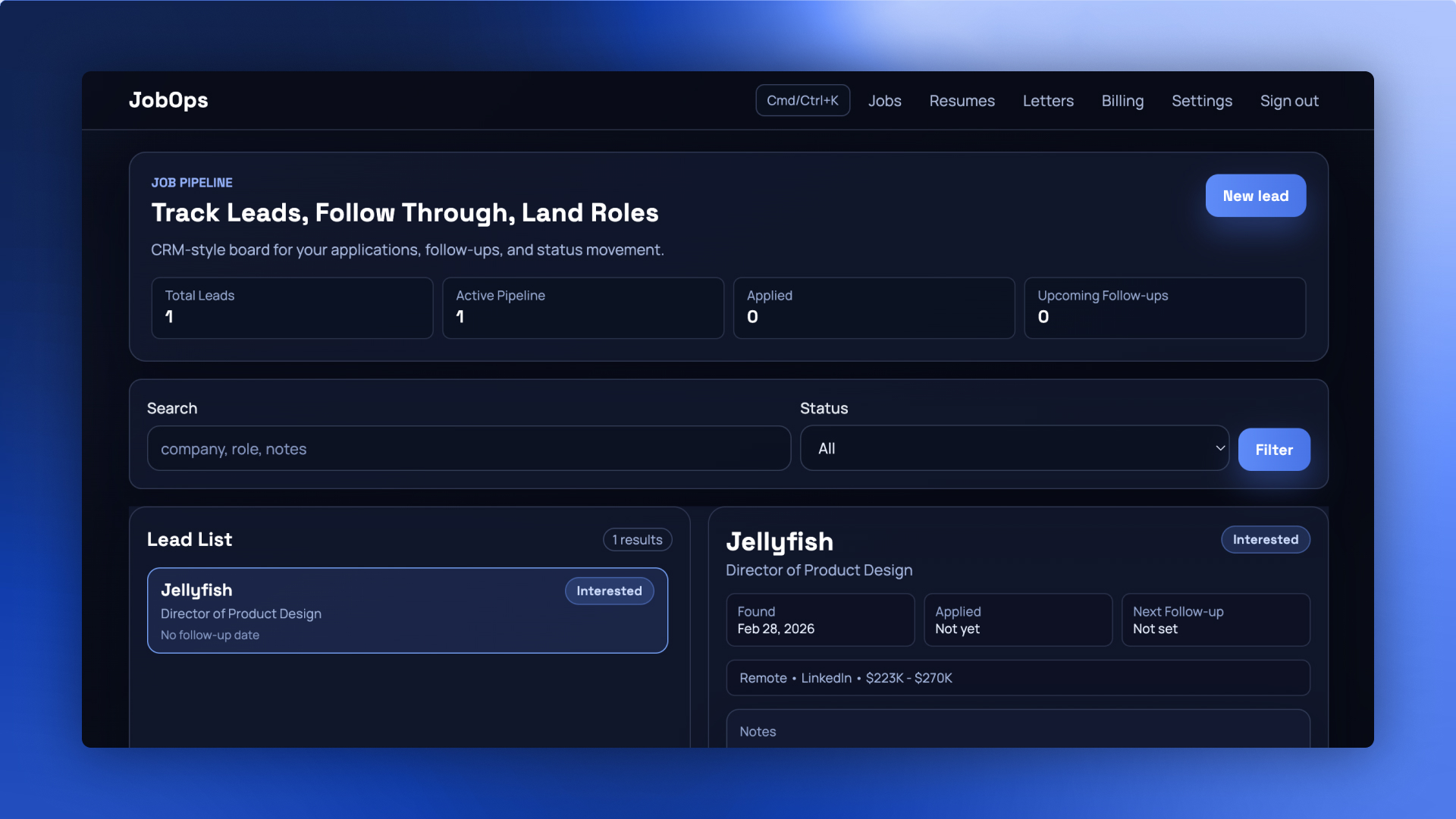
Job Ops is an operating system for modern job search. The primary users are high-agency professionals managing multiple role tracks and operators supporting career pivots where consistency and speed both matter.
Problem
Most job searches fail operationally before they fail competitively. Execution lives across scattered tools, inconsistent tracking, and low-signal follow-up habits. Strong candidates lose momentum because there’s no single view of pipeline, version control for messaging, or structured cadence for follow-up.
Your Role
- Led product strategy and UX design
- Designed pipeline, application-quality, and communication-cadence layers
- Built decision intelligence (dashboards, scoring, next-action logic)
- Owned end-to-end product architecture and interface patterns
Approach
I structured Job Ops as an operating model, not a checklist app. The product is built around decision points: where to focus, what to improve, when to re-sequence effort. Role intake is standardized so opportunities are scored before effort is spent. Resume and cover letter versions are tied to role archetypes. Follow-up becomes a timed cadence. Weekly signal loops let users improve pitch quality and targeting.
Outcome
Core workflow architecture and interface patterns are established. Next milestone: private pilot focused on conversion uplift and cycle-time reduction. Expected impact — faster application-to-interview cycles, higher-quality submissions through version governance, and better strategic focus through weekly performance readouts.